Monday, October 31, 2005

Happy Birthday Katie!

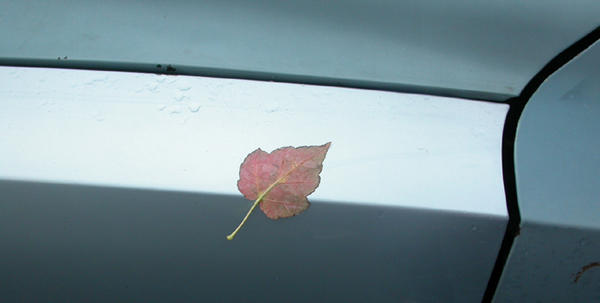
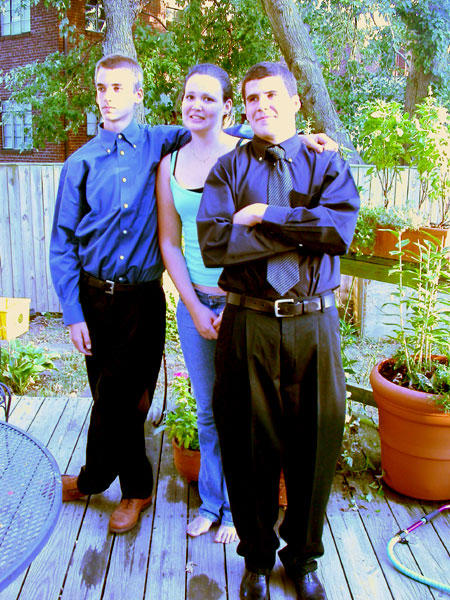
One of my favorite images taken by my darling daughter. see more of her work here
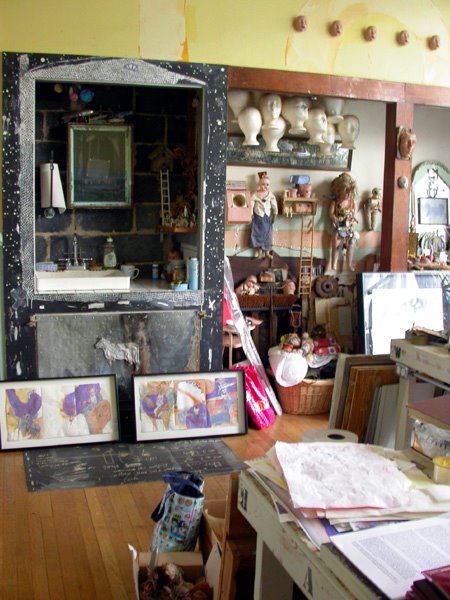
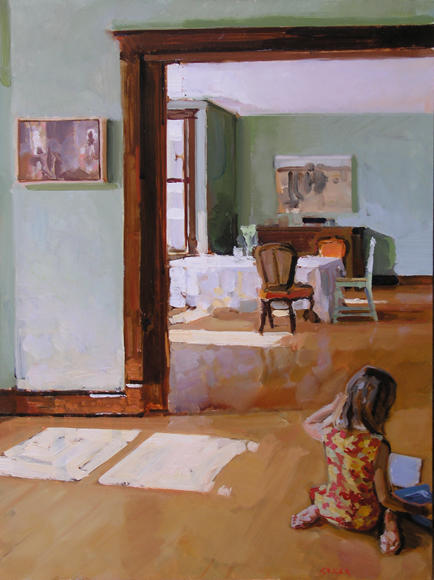
Rebecca Silberman's studio, her two journal pieces for the Voices and Visions show are on the floor.

Saturday, October 29, 2005

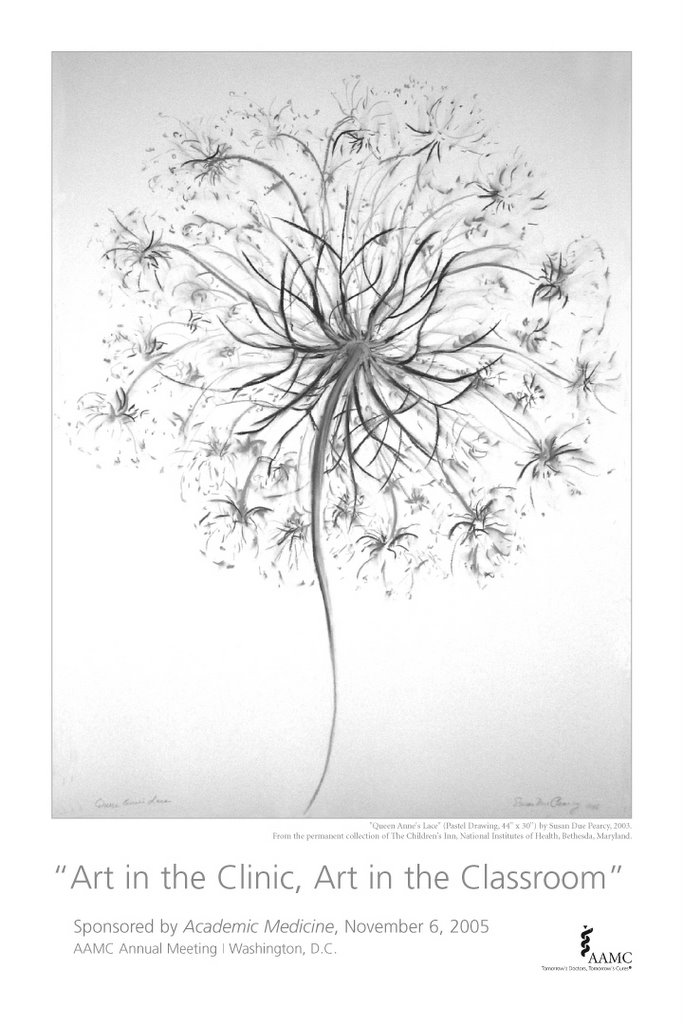
"Art in the Clinic, Art in the Classroom" at the AAMC Annual Meeting

Susan Pearcy's poster "Queen Ann's Lace" will be avaliable for sale, all proceeds will benefit the NIH Children's Inn.

Susan and I will be speaking at the Association of American of Medical Colleges, along with Therese A. Jones, PhD (University of Texas Health Sciences Center at San Antonio) and Julie M. Aultman, PhD (Bioethicist and Assistant Professor in behavioral sciences, NEOUCOM)

Sunday November 6, 10 - 12. Read more about it here

Baby Church

Friday, October 28, 2005

Rebecca's studio

Tuesday, October 25, 2005


off to my wonderful Charlottesville tomorrow morning

Bert Shankman

I own this gorgous photograph "Weston" by Bert Shankman. He named it after the great American photographer Edward Weston (I think from a comment David Tannous made when reviewing his portfolio) But to me the petals feel like rich fabric, the pose elegant, somthing like Cecil Beaton. (example... Audrey Hepburn)


We have exhibited Bert's beautiful prints at the US Botanic Garden and NIH, he will also have work in our Voices and Visions show this November. His work is in the permanent collections of NIH, Children's Medical Center and Martha Jefferson Hospital. Bert has kindly donated his work to support Smith Farm and the Society for Art in Healthcare.


Bert's artist statement below:

My passion is to see beauty in life as I interpret it through the form of flowers. Flowers are my metaphor for life. I see birth and death, pain and joy, agony and ecstasy in flowers. My objective is to give shape, texture and color to my feelings through the images I photograph. I am intensely passionate about my work.
I record an image on film by 'playing' with sunlight using the different lights of the day and different qualities of filtered light. Many times I am deliberately seeking a preconceived image but frequently I find the spontaneous. The work I do in my 'dry darkroom' is just as important as the 'work' I do behind the lens. The image is not complete until I am satisfied with it as a print.
My goal is to create images where I can 'see' my feelings and to share those images with others.

Visit Bert's web site here

also Peggy's kitchen
two little sculptures in Peggy's kitchen

Monday, October 24, 2005

driving home in the rain


wonderful time with Mark and Peggy. Great food and conversation.

Smith Farm

Visit Smith Farm's updated web site here

The Poetry of Random Moments

Mark Isaac, Peggy Fleming and I meet tonight to discuss our show at Strathmore Hall in January.

The Poetry of Random Moments
January 6 – February 18, 2006

Images are all around us at all times, but often we move right by them without taking notice. Even when we see them fully with our eyes, they do not fully register in our minds or in our hearts. At unexpected moments, some images achieve a rare synchronicity of beauty, revelation, and impact. These moments, often random in nature, deserve to be captured and savored longer than our fast-paced lives permit.

In November 2003 three very disparate photographers, Peggy Fleming, Mark Isaac and Lillian Fitzgerald, began to formulate the idea for this exhibit, titled "The Poetry of Random Moments." The exhibit explores the beauty created by photographing everyday objects and scenes from nature at chance moments when unexpected beauty and meaning is revealed. The three photographers explore this beauty in a variety of ways -- by photographing in a series; exploiting motion, reflection and visual distortion; and creating unique and unexpected photographic collages. But in each case the hidden is revealed, the mundane is made exceptional, and the chance moment achieves lasting significance.

Our work will be upstairs Barbara Southworth and Clifford Wheeler's photography will be downstairs.

Sunday, October 23, 2005

Saturday, October 22, 2005


just spent 2+ hrs with Gabe at DMV. Took his learners test and missed this sign. ah me...

Prince Charles is visiting NIH

"The value of art is widely appreciated in the world of healthcare, and I have seen some interesting examples of good work done to integrate art into the life of hospitals and clinics. But I would go further than this, and ask if we cannot truly integrate art into the very buildings themselves, since there can be no doubt that being surrounded by beauty is likely to assist our health, as indeed, a growing body of evidence seems to suggest."

Totally love this quote, read the rest of his speech here

Friday, October 21, 2005

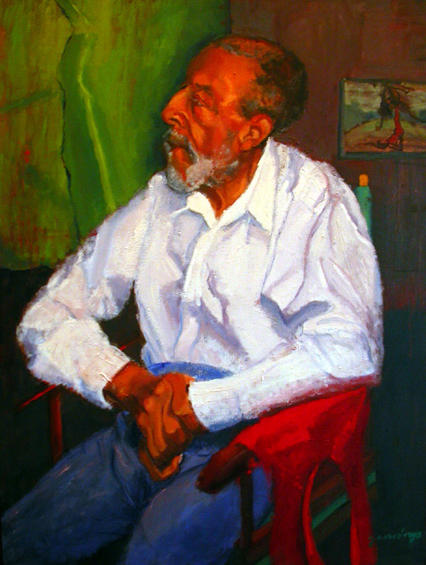
The Final Pose of Mr. Nesbit by Pam Jennings

This painting is in the permanent collection at NIH. As many of you know, Russell was an amazing model, a favorite of many of us who drew in life classes at the Smithsonian in the 80's.

Pam's artist statement below

Russell Nesbit was perhaps the most well known muse for Washington area artists. This was true for students and teachers alike. He started modeling decades ago to help make ends meet when it was difficult, largely because of segregation, to get work as an acrobat, his life’s love.

Russell’s last modeling job was sitting for this portrait in the fall of 2001. He was very ill with colon cancer but he insisted on working. He got so sick that he was too weak to take public transportation from his home in DC to my studio in Alexandria, Virginia. I would drive him to and from my studio. He was so proud of the idea that he was the model for three paintings in my first solo show which was at the Art League in Alexandria.

As I painted Russell I knew that my work was about much more than a show preparation. I was recording the last days of a wonderful man whom had led a wonderful life. Russell was a very patient, generous and nurturant model. While we worked he educated me about jazz and told me fascinating stories about jazz artists. One of my favorite stories is about how much Russell loved Billy Eckstein and how he would follow the singer around the country as he performed. Russell also told me about his background as an acrobat and his experiences with discrimination which included exclusion from the Ringling Brothers Circus. He trained young black girls from poor neighborhoods in acrobatics. He told me that he and his students were once invited to do a private show for Ethel Kennedy. He studied photography at the same school as Jackie Kennedy and in the army he helped train parachuters how to jump.

Sometimes I was at cross purposes while working with Russell. The painter in me wanted to paint but the Clinical Psychologist was interested in knowing more about his developmental history and how it shaped his character. For example, I was very interested in the fact that he was adopted and had never met his biological parents. He once told me that he had the fantasy that they saw him when he performed on shows like the Ed Sullivan show.

The psychological dignity of this final pose was in direct contrast to the way that cancer was undermining Russell’s physical integrity. The merciless and ugly process of death was the opposite of the beauty that my eyes wanted to observe and that my hands wanted to render. The cancer was violent. Once, Russell threw up in my studio. It was painful to watch the disease eat away at him as his weight declined. Sometimes his feet and ankles were so swollen that he could not wear his shoes. I remember going to a shoe store to try to find some very wide but warm shoes. I wanted to surprise him! There were moments when Russell was so weak that I had to take him to the hospital where he was given blood transfusions. Apparently he was bleeding internally. Through all of this Russell wanted to work and he did so without complaint.

I hope that this pose captures this quiet, dignified man’s fight with death, and more importantly, his love of life. Yes, cancer was killing him and he was physically fading away as evidenced by the largeness of his white shirt. However, his courage and his sense of responsibility to art were eternal traits that would never end.

While this portrait was very much motivated by my need to produce work for my show, my own medical history was inseparable from Russell’s experience. At the age of 19 I had a malignant parotid gland tumor that was surgically removed. Although I survived cancer, this experience has been omnipresent in my life. So, my portrait of Russell is also a portrait of me. If this portrait gives comfort and hope to even one fellow patient both Russell and I will be very happy.

Great Concert by Rodney Truitt yesterday at NIH

Thursday, October 20, 2005

Kay Chernush

This beautiful photograph will be in our Voices and Visions show at NIH in November. Visit Kay's web site here

More of Kay's images and artist statement to follow.

Small Town in the Big City

My good friend, Peggy Fleming has published a new book
Small Town in the Big City. It is a charming read, full of interesting historical facts about the buildings along a four block stretch of Connecticut Avenue and the people who work there. Peggy photographed and interviewed over 70 people, Joanne Zich researched and prepared the historical notes. more about it here

In Peggy's previous book In Her Place, 56 women are in their chosen places or spaces or activities, where each is comfortable, centered, nurtured. Photographs are by Peggy, each text is by the woman in the photograph.

Below a page from In Her Place...


ADAMA SALL

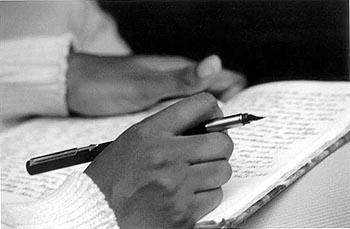
Writing is
peace of mind; a
fresh piece of paper and a
great pen that will just
flow across the page. My ideas,
fears and hopes are all down on paper.
They wait,
for whenever I'm ready
to deal with them.
1996

Find out more about In Her Place here

Wednesday, October 19, 2005

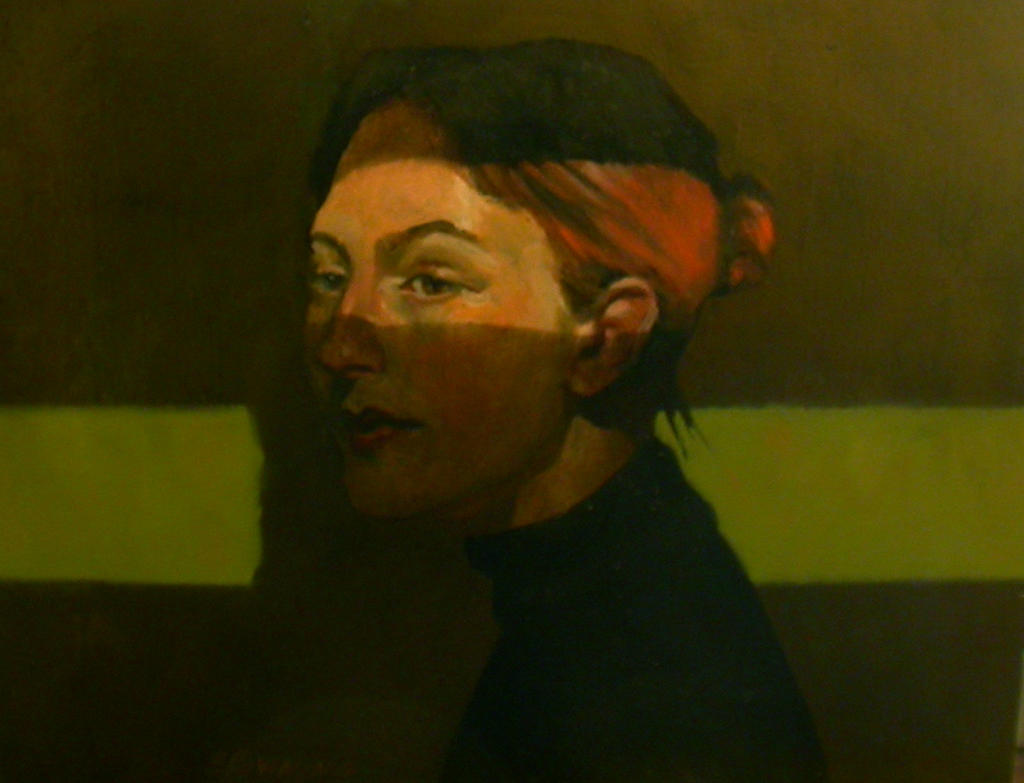
My beautiful Rob Browning painting "Suzanne with hair in bun"

Larry's desk

KT sent me this web site

Dan Witz visit it here

Tuesday, October 18, 2005

Duane's painting of the day today...... and


an interesting post... here

to me, no one paints like Duane. Susan and I visited him in Richmond a few weeks ago and his motivation is to literally paint a painting a day. His work celebrates life, the change of the seasons, daily inspirations, close observation. He is the most charming of men.

Rather than worrying about artists duplicating Duane's blog, I think artists should follow his lead and control their own destiny.

Rob Browning


yet another great Charlottesville artist!

Susan and I visited Rob's studio last time I was there. We purchased several paintings for MJH and I bought his painting "Suzanne with hair in bun" - which I treasure. I will post an image of it tomorrow.

Rob has a strong illustration background and a beautiful, rich painterly style. He has also done a series of little square drawings each one more interesting than the one before it... I suggested he start a "drawing a day' blog, he was already familiar with Duane's work - so look for it here. Rob is exhibiting two paintings in our NIH/SAH exhibit in November.


Rob's artist statement:

My paintings are of scenes which I find to be anxiety- provoking, humorous, beautiful or grotesque.

While my artwork is meant to faithfully document a scene, in painting it, I will often caricature, delete or alter scale if I feel that doing so makes the painting better communicate my initial response.

Email: browning1000@earthlink.net


Sunday, October 16, 2005

Crew races this Sunday, last Sunday


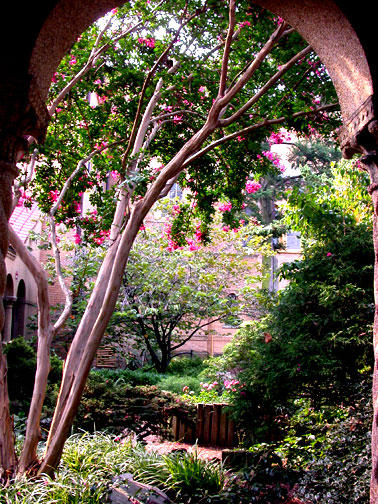
The garden at the Franciscan Monastery

Saturday, October 15, 2005

Don Fear


“Healing Steps: Jamie’s Journey”
Excerpts from a Caretaker’s Journal
Photo-Assemblages and Writings by Don Fear

Signs, symbols, and objects—what do they mean to us? Objects given and received, gifts. Gifts given from the heart, when illness hits, often take on a different meaning than what a simple object may be able to convey. A crystal with healing powers, a handmade angel for the Christmas tree, a figure of Yoda—all take on a different meaning, one of importance. They become more than just objects; they become symbols of hope and connections to another world, the spiritual world. These objects, minute as they may be, are gifts of hope and most of all love. Cards by the hundreds, best wishes for recovery and good health from loved ones and friends. Objects of paper, maybe, but they are much more. They become connections with loved ones who are near and far away. They hold us together when we are apart.
The importance of these objects has become more evident since my wife’s diagnosis. A lot of things have become clearer. Jamie and I are realizing how deeply we are connected. Our spirits are together forever, the untouchable and the unseen.
One day she said to me, “We need to document the many gifts that people have sent.” The connection was already there, made without being spoken. I had been doing exactly that. Over the previous days, I had been scanning the objects we had received. Objects often disappear and quite frequently get covered up by other important things. Jamie and I had been on the same wavelength. For some unknown reason during her three surgeries, I had been collecting bits and pieces of discarded medical items, packages from tubing, latex gloves, hospital ID bracelets, and any other items that I could scavenge. I don’t really know why I had collected these things. It was as if I were driven to collecting anything I could hold on to that had a connection to her. A friend of mine whose wife also has cancer revealed to me that he had also had the same urge but didn’t know why and had stolen a pair of examining gloves. I said to Jamie, “You are not going to believe this” and then walked down to my studio to get some of the images that I had made. When I showed them to her, a tear appeared in her eye. I reached out and we just held each other.
This was the beginning of my documentation of our healing process—photo assemblages and writings of things, places, dreams, and memories that we have shared since her diagnosis of a rare cancer, mucinous cystadenocarcinoma. Some of the objects in the images live on the windowsill of our guestroom, overlooking an area of woods. It is a great window to study the change of seasons. Jamie looks out over these woods, accompanied by the many objects she has received; among them are her favorites, the butterflies, which have become her symbol of healing and a visualization tool. Her collection includes several pins, magnets, and a large wooden butterfly from Bali that dangles from the ceiling, a gift from her older sister.
As she stands there looking and touching each one, I can’t help but think that at times, a lot of times, she might just want to become a butterfly and lightly and effortlessly take off and leave her body, if only for an afternoon of cruising the woods that she so loves. The image of the butterfly allows her the opportunity to leave her body and enter that place in her mind that says anything is possible. Producing this work allows me to clarify both my own existence and what Jamie means to me

Don has exhibited this work at Smith Farm, NIH, Martha Jefferson. NIH purchased three from this series for their permanent collection.

Friday, October 14, 2005

This is what I did today.... 10 guesses

Mary Margaret Pipkin

yesterday I posted an image of NIH then and now. Mary Margaret's watercolor of a pink rose was in the "now" photograph. visit her web site here

Architects vs artists

Interesting post in Edward Winkleman's blog read it here

Jim's desk

Thursday, October 13, 2005

Raph # 54

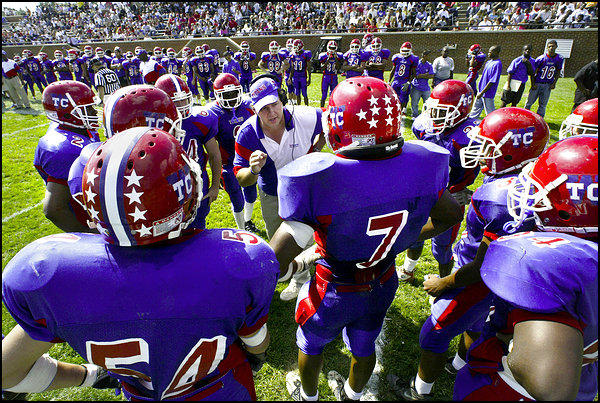
Crafting a New Script for Titans Football
Third-Year Coach Works Hard To Resurrect Storied Program
By Liam Dillon Special to The Washington Post
Thursday, October 13, 2005; VA12

Greg Sullivan's geometry classroom, in the back of a trailer, sits on the 20-yard line of the old football field at T.C. Williams High School. Through his window, he can see the construction of the new, nearly $100 million school building that is scheduled to open in two years.
"I like to watch the guys as they're building," Sullivan said. "Hot or cold, rain or shine, they're out there making something great for the kids and the city."
The same might be said of Sullivan. As coach of the football team at Alexandria's lone public high school, one of the most famous in the country thanks to the movie "Remember the Titans," Sullivan has erected a solid foundation on which to rebuild a storied program that was a shambles when he took over three seasons ago. And he has had to endure everything the workers outside his window have endured.
Hot or cold? Sullivan's team was the popular preseason favorite to win the Virginia AAA Patriot District title. But after three victories to open the season, the Titans have lost three straight games.
Rain or shine?
On Friday, a day when most of the teams in the Washington area opted to avoid the elements, T.C. Williams disintegrated in the mud at Lee High School. With that loss, the Titans need three victories in the season's final four games to have their first winning season since 1995. And like their first six games, none of the remaining four will be played at home, because of the school construction.
Winning seasons and playoff appearances were common for the Titans in the 1970s under Herman Boone and in the '80s under Glenn Furman. The team won three Virginia state titles in those decades, with the first coming in 1971 under Boone, a black coach who was chosen over a white job candidate to run the football team at the then-recently integrated T.C. Williams.
But by the time the story of Boone and his unforgettable Titans hit the big screen in 2000, the current Titans had hit bottom. When Sullivan was hired three years later, T.C. Williams had gone through five head coaches in 10 years -- including a three-time Maryland state champion, a top assistant to Furman and a longtime NFL linebacker. The Titans lost more games in that 10-year span than they had in the previous 26 seasons. Their last playoff appearance came in 1990.
Fans responded in kind, pelting the players with popcorn after one loss and cursing at them. One spectator walked up to Sullivan after a game in his first season and asked whether Sullivan knew who was in charge of hiring and firing coaches: The spectator was sure he could do better than Sullivan. The Titans' first victory of the year, in their season finale, broke a school-record 16-game losing streak.
Less than two years later, the Titans are confident of success.
"Our last winning season was back in the mid-90s," said T.C. Williams Principal John Porter, who has been at the school for 21 years. "I thought back then that it might be a turnaround, if you will, but it ended up being [just one] season. But I'm feeling real good about the long-term effects now, with Greg working this program. You can see it in the kids' faces. It's a mental change, an attitude."
On the Right Path
Although he was never a head coach before coming to T.C. Williams, Sullivan, 44, most recently had success as a defensive coordinator at Randolph-Macon Academy in Front Royal, Va., and before that as offensive coordinator at Ottawa (Kan.) College. Earlier, he had assistant coaching stints locally at Stuart, Marshall, Mount Vernon, Chantilly and W.T. Woodson high schools. Growing up in a military family, Sullivan moved around quite a bit before graduating from Marshall High in 1979. He started coaching in college, taking his first high school job while attending George Mason. He graduated from New Mexico Highlands University, which helped Sullivan with his tuition in exchange for his help on the school's coaching staff.
Among Sullivan's peers, there's little doubt that he is the right person for the Titans. West Potomac Coach Eric Henderson, who was coach at T.C. Williams when "Remember the Titans" came out, is a longtime friend. He talks with Sullivan weekly and likes what he sees at his former school.
"Everyone needs to just be patient. Greg's on the right path," Henderson said. "He's no-nonsense and the kids respect that. He's the right type of person for that situation. There's a spot for every football coach with some talent to be successful. He has the right temperament for the job."
After Sullivan was hired, he instituted a three-year plan to overhaul the program. The first year, Sullivan concentrated on discipline, getting the team in shape to play. In year two, Sullivan's goal was to be competitive, and the Titans were, finishing 4-6. This year, Sullivan's focus is winning. To that end, Sullivan has replaced 10 assistants in the past two years. Sullivan's brand of discipline recalls the movie depiction of Boone's summer training camp at Gettysburg College. Each summer, Sullivan takes the team to Randolph-Macon, his former school, and errant players are made to run the 120-yard-long "Hill of Correction," which goes up at a 45-degree angle for the first 80 yards and then to 60 degrees for the last 40 yards. On the first day of practice in 2003, he spent the first 45 minutes setting up the team to do jumping jacks, making his players start all over again when they couldn't toe the line.
"I wanted them to line up under the goal posts, run up, put their toes right at the line," Sullivan said. "Not on the line, not behind the line."
"It was pure comedy," he added with a chuckle. "I wish I had filmed it."
Although the players certainly didn't enjoy the experience, they have grown to understand its importance. And it certainly hasn't hurt turnout; the Titans now carry 165 players in the program -- more than double the number participating in Sullivan's first season.
"We respect him," senior Casey Muhtadi said. "There's no doubt about it. We know that he's here to help us. He's one of us. He's a Titan."
Muhtadi noticed a difference in the football program's attitude from when his brother, Dean, a 2004 graduate now playing at Christopher Newport University, attended the school.
"There was no winning attitude," Casey said. "They would go into games just knowing they were going to lose. They just wanted to play football and were fine with just that. But now we go into every game with the expectation to win. That's something Coach Sullivan brought here."
The respect goes both ways. In T.C. Williams's homecoming game Oct. 1 against Lake Braddock, the Titans scored a potential game-tying touchdown midway through the fourth quarter. On the extra-point attempt, freshman backup quarterback Jamal Ford noticed that the Bruins had only 10 players on the field. Ford called an audible, opting to forgo the kick and run the ball instead. He didn't reach the end zone, and the Titans eventually lost the game, 7-6. Afterward, Sullivan said that Ford made the right call and that he would want him to do the same again if the situation arose.
It's no surprise that a freshman would feel comfortable in Sullivan's system. All three high school teams -- freshman, junior varsity and varsity -- work together during practice in individual position drills. Part of Sullivan's rebuilding involved focusing on the team's lower levels to create a culture of winning that in time would bubble up to the varsity. Sullivan is fond of pointing out that the freshman team went 8-0 last season and that the junior varsity also had a winning record.
"You want to get into the other team's head that we're used to winning," Sullivan said. "You want them to ask, 'When was the last time you beat T.C.?' You didn't beat them as freshmen, didn't beat them as sophomores. Now you think you're going to step up to the plate and beat them as juniors? Good luck. . . . We're going to put it on you one more time just for general purposes here. It's just part of the psychological game that we didn't have before."
The emphasis on youth also has allowed Sullivan to hold on to some players who might not otherwise have stayed. Standout freshman fullback Dominique Copeland, who played on the Titans' freshman team as an eighth-grader and this season is among the Patriot District rushing leaders, said that part of the reason he decided to play at T.C. Williams instead of at a private school was that he was impressed with the program's winning attitude.
And Sullivan's involvement is not limited to high school players. He embraced a decision made just before he arrived to change the name of the teams in the city's recreational leagues to the Titans and their colors to the blue and red of T.C. Williams. When the rec leagues had a fundraiser selling hats that said "One City, One Team," Sullivan bought a set for his coaching staff. This year, he gave out blue "Titans For Life" bracelets after the high school training camp but ordered enough for the rec leagues to give to their players.
"He's raised the coach's involvement with the rec leagues to a higher level," said Jim Gibson, the commissioner of Alexandria Titans Youth Football and a 15-year coach. "He's taken a deeper plunge. . . . He gets involved in the philosophy and development where other coaches haven't. Those unifying efforts have rekindled interest and excitement about T.C. Williams football that I haven't seen in a long while."
Seeing the Light
With the ongoing construction, T.C. Williams has no home field, is unlikely to have one for the next two seasons and is practicing on a makeshift, dirt-filled field at nearby Chinquapin Park. That field is six yards too narrow. The Titans' "home" games this season are at Edison, Episcopal and West Potomac. Still, players and coaches refuse to blame the field situation for any problems during games.
"If we can do good on [the practice field], we can do good on any other field," Copeland said.
T.C. Williams plans to rebuild an on-site facility after the new school opens. That field will be similar to the one it is to replace and should be available by September 2008, said T.C. Williams Athletic Director Kerry Donley, who was mayor of Alexandria from 1996 to 2003.
The on-site stadium, however, pales in comparison with the benefits of a proposed All-City Sports Facility planned for Joseph Hensley Park on Eisenhower Avenue. The facility would include two ball fields and a lighted, multipurpose, artificial-turf field, which would be home to T.C. Williams football, other sports at the school and to local recreation leagues.
The All-City facility would cost $11.7 million, a figure revised downward after planners eliminated a proposed track, said Donley and Mark Jinks, assistant city manager for finance. If the initial plan is approved at a City Council meeting scheduled for Oct. 25, the city will begin private fundraising to raise half the cost of construction. The goal is to open that facility by September 2008, as well.
If the All-City facility is built -- Donley says its chances are "50-50" -- it also would mean the introduction of Friday-night football at T.C. Williams. The field at the school, which opened in 1965, has no lights, in accordance with an agreement made with nearby residents when the field was built.
The school is the only one of 31 in the AAA Northern Region that does not play Friday-night home games, a fact that Sullivan is reminded of when he looks around his classroom: On the wall are promotional posters from yet another high school football move, "Friday Night Lights."
"It's a bit discouraging to look at them all the time," Sullivan said with a smile. "But we're going to have it in '08."
But the difference between night and day is not just a stadium question -- it's how others see T.C. Williams football of today versus the program of a few years ago.
"I'm just so proud to see them back on the winning track," said Boone, the former coach. "Coach Sullivan is doing one heck of a job. He has allowed those kids to take their knocks but kept their pride up, and now look at them. They're Titans again."
© 2005 The Washington Post Company

NIH then and now

Wednesday, October 12, 2005

From our friends at USBG

Garden Photography Using a Digital Camera
Sandy Webber, Writer and Photographer

Learn how to make compelling digital photos of plants and gardens with an automatic or SLR-type digital camera. Following a slide-show review of basic digital camera features and controls and principles of exposure and composition, participants will practice what they have learned by taking photos in and around the Conservatory. The instructor will answer general questions about taking digital pictures and provide hands-on assistance and feedback. Participants should be very familiar with their camera controls and bring both the instruction manual and fresh batteries to class.
**Please note: This class will be repeated on Saturday, October 22. Please only register for one day.

Code: W102105
Location: Conservatory Classroom
Date: Friday, October 21
Time: 8 a.m. – 12:00 p.m.
SONG Member: $55
Non-member: $60
Pre-Registration Required

Code: W102205
Location: Conservatory Classroom
Date: Saturday, October 22
Time: 8 a.m. – 12:00 p.m.
SONG Member: $55
Non-member: $60
Pre-Registration Required

REGISTER


The United States Botanic Garden • Architect of the Capitol

Philip Geiger


Saw this beautiful painting, "End of June" by Philip Geiger at Principle Gallery yesterday.

Philip Geiger is associate professor of art at the University of Virginia in Charlottesville. He was one of the first artists we found when we began to work on the Martha Jefferson Hospital art collection. Anyone who has seen his work, knows they are beautifully crafted, light filled, lyrical works of art.

The gentleness and intimacy of his paintings are exactly the feeling Susan and I looked for in the MJH collection -- rich in imagery and texture - providing a momentary escape for patients, a diversion for visitors and engaging the interest of staff. Images that explored rural and urban Charlottesville and figurative works of art that emphasize creativity; painting, gardening, music, calligraphy, children at play.

Alas, Phil's work is pretty expensive, so we don't have one of his paintings in the collection .... yet.

Tuesday, October 11, 2005

Lynden Cline

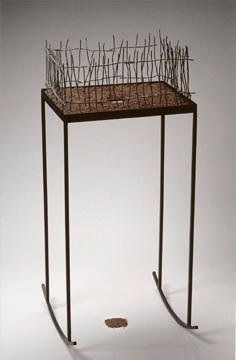
This is Lynden Cline's sculpture titled: In Spanish, the word "to wait" is the same as the word "to hope"...esperar

It was also exhibited in the Flora Show at the US Botanic Garden. I love this piece especially in the context of the show. Surrounded by so many beautiful images of plants, it was heartbreaking. I keenly felt the absence of life, this little fenced in plot where a garden should be...

Lynden's artist statement below:

Much of my recent work centers around feelings I have about identity and about family. This issue is complicated for me, as I was adopted. I have never been in touch with my biological family, and a period of time passed before I was placed with my adoptive family. Frequently, I start out thinking that I am working through some particular feeling about my biological family, but later come to realize that my adoptive family is the screen by which I judge all family relationships. It is impossible to separate the two.
Working with emotional material pre-dating even my own birth, I submerge myself in the painful feelings -- I sometimes sink to the bottom, unable it seems, ever to rise to the surface. My husband asks "Why do you torture yourself?" I don't think that I am strong enough to be an artist. This job, this commitment I have made to myself to make art -- art that is as much a part of me as my hand. Art that spills the contents of my soul onto the floor.
I work from my heart. I frequently cry when I am putting a piece together. It is difficult to say what each piece means, or what each element means. I try to just move steadily forward. I typically do no sketching, no concept work, I just start with an element -- a fence, a chair, a tree. I believe in forces outside myself, they guide me. I am overwhelmed by the process, as I am overwhelmed by the reaction people have to my work. I never thought that work so personal, so full of my feelings, could touch others -- in ways, I'm sure, that are both different and similar from the ways it touches me.
I don't live with my sculptures. They sit, stacked up, in pieces in my studio. Sometimes, just being there with them can fill me with feelings of pain. They are like animals, hiding in the corners.
Most of my pieces border on monochromatic: the natural color of steel; copper sheet with a patina that darkens it to dark blue/gray with streaks of pink; walnut stained to a dark, warm brown. It's steel that speaks to me the loudest. Several years ago, I was mystified by metal. Drawn to it, but sure that I could never have what it takes to work in it. But I felt its energy, its sureness and its depth. I now find joy in the process of manipulating steel. I love the noise, the heat, the sparks, the challenge. The physical act of translating feelings into a structure is a valuable part of the process of my art. It takes strength from me and gives me strength in return.
I have shown my work as an object-based installation -- showing several pieces in a room by themselves. I have hung metal branches from the ceiling and used old wooden gates to break up the space. Gorecki's 3rd symphony played in the background. At one of these shows, a local curator described my work as chapters of a book. I was touched by another who said that my work was poetry.
Lynden's web site here

Sunday, October 09, 2005

Philip Kohn "The Looking Glass" at NIH

"The Looking Glass"
Interactive video art
by Philip Kohn

Philip Kohn is a researcher studying brain function in the Section on Integrative Neuroimaging at the National Institute of Mental Health. During his eight years at the NIH, he has been involved in studies of memory, schizophrenia, Williams syndrome, aging, reward and story comprehension. His interests in artificial and natural intelligence, evolution, photography, psychology, interactive arts, mathematics and computer science have come together both in interdisciplinary study of the brain, and in the creation of new works of art using technology as a medium.
In 2002 he had his first public showing of an interactive video installation called "Once Upon a Time." This piece allowed participants to add their own short video segment to the ends of a growing story tree. He was surprised by how easily people shed their inhibitions in the context of seeing themselves "on display" as part of an art work. He decided to further explore audience participation in interactive video art with the idea of creating media which would engage people in the creative process.
Making art and designing experiments both involve playing with possibilities to best bring to light the effects of interest. In both the result is often not what was expected. Having an open mind to the unexpected is part of the creative process in both art and science.
While making "The Looking Glass", there were many happy surprises that were part of the interplay between artist and medium, or between imagination and reality. For example, the method used to separate people from background had the side effect that standing still causes you to disappear like the Cheshire cat in Alice in Wonderland with the eyes and mouth disappearing last. At first this seemed like a problem, but then the realization came that this was a wonderful way to encourage people to move around. One of the goals from the start was to make something that would cause people to dance around and act strangely becoming their own exhibit for others to wonder at. The hope is that the playfulness that went into the creation of The Looking Glass will be echoed by the play induced in its audience.
Just as we sound different to ourselves when we hear our voice played back, we also look different to ourselves when the bonds of immediate reality are broken. This installation breaks down the reality of the mirror in time, space and color. Every minute it changes the type of distortion. Some of these include: time delay, warping the image when you move your hand across it, drawing with your hand, time speed up and slow down, time forward and backward, time re-splicing, mirror flipping, rotation, coloring and zooming selected colors.
Note that no video is saved for more than a minute, and that this exhibit is completely self contained without any connection to other computers or networks.

How cool is that?

Philip's email here: philipkohn@gmail.com

Saturday, October 08, 2005

rain rain rain

Friday, October 07, 2005

Took this photograph at the National Gallery of Art today. I went to see the Winslow Homer show, it was luscious. What an articulate painter - painterly and yet so precise. I rarely bother to read labels but in this show they were really interesting, giving insight into the artist's favorite works, what he was trying to accomplish, etc.

Also visited my favorite Vermeer, Girl in a Red Hat and saw the Pieter Claesz: Master of Haarlem Still Life exhibit. So very beautiful.

Just the thing to do on a rainy Friday afternoon...

Margaret Boozer

This is the Margaret Boozer sculpture I purchased last year at the Society for Arts in Healthcare Auction.

I love it's immediacy. Its at the bottom of a staircase right next to the kitchen. Inevitably someone will be standing in the doorway talking to me while I’m cooking and will start touching it, almost without thinking. It is delightful to own a work of art that is so interactive (It makes me question what a static medium painting is) Even people who don't understand it end up enjoying it in spite of themselves.

Margaret is creating a site specific work for the "Voices and Visions" show we are having this November at NIH in partnership with SAH. It will stay up through the summer.

Visit Margaret's web site here

Thursday, October 06, 2005

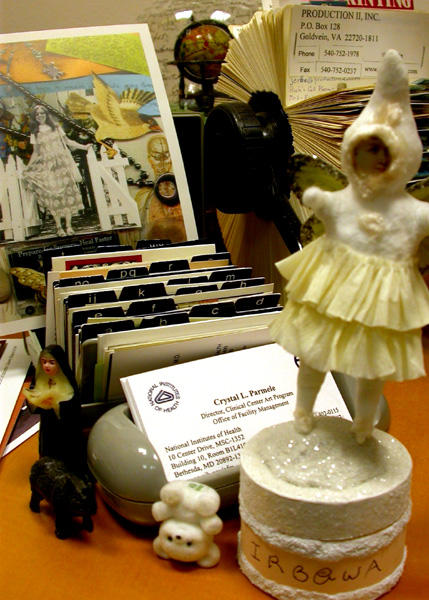
Crystal Parmele's desk

Sandra Humberson's quilt at NIH


Subscribe with Bloglines